

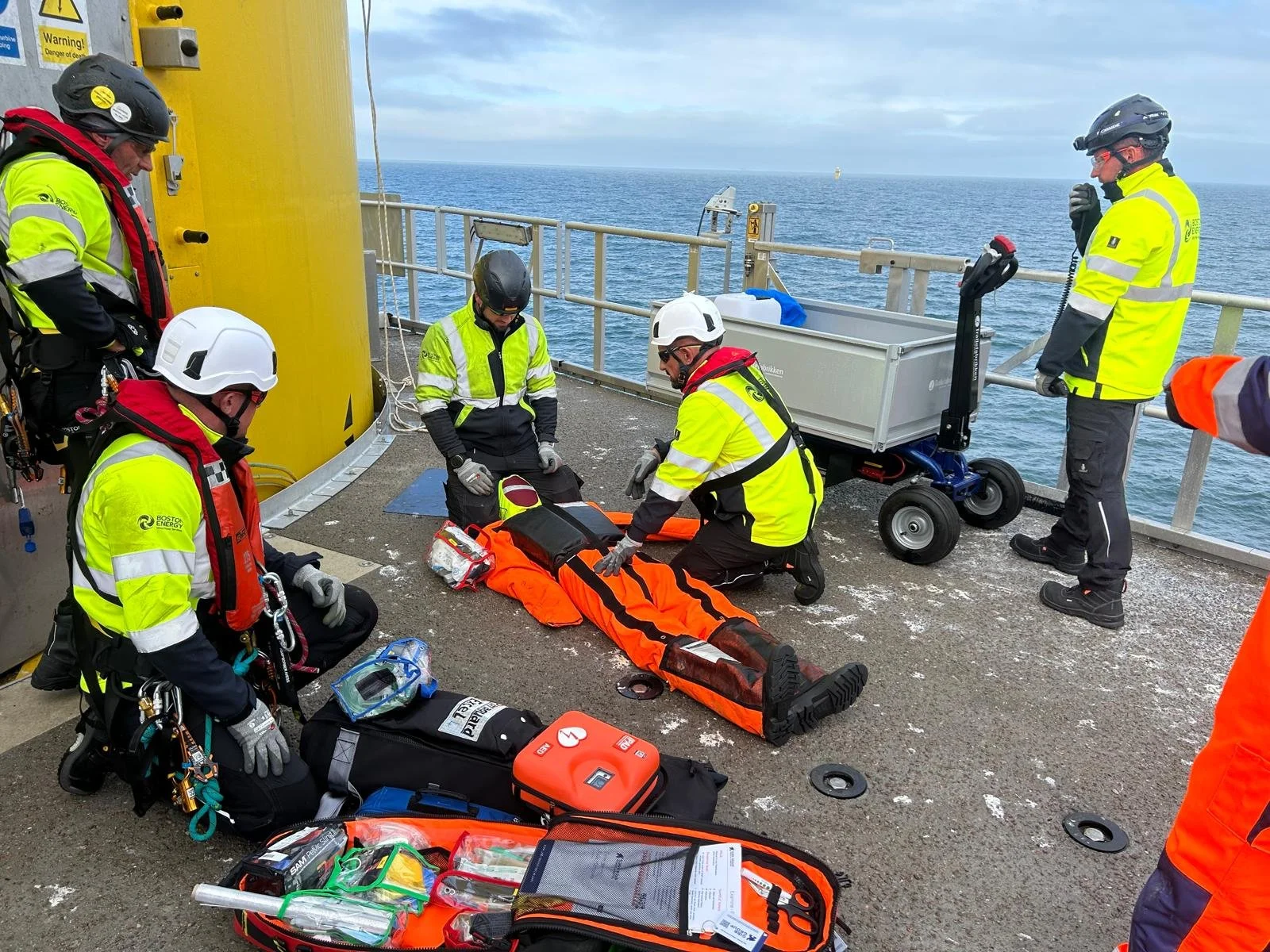
Medway Access & Rescue provided ongoing rescue and first aid training to the rope access painting teams working on an offshore wind foundation. The aim was simple: if someone is hurt while suspended on ropes, a long way from shore, the team around them has to know exactly what to do.
Support Services Provider: Medway Access & Rescue
Client: Offshore wind client (name withheld)
Services Provided: Developed emergency response training and rescue drill scenario
Project Location: Offshore wind farm
Sector: Offshore wind energy
Objectives:
Train the rope access team to rescue a casualty from the ropes to the working platform.
Build confidence in first aid, CPR and AED use under pressure.
Practise passing clear casualty information to the vessel medic in the ATMIST format.
Rehearse a full casualty evacuation across the walk-to-work (W2W) system to the vessel hospital.
Project Overview
Medway Access & Rescue provided ongoing rescue and first aid training to the rope access painting teams working on an offshore wind foundation. The aim was simple: if someone is hurt while suspended on ropes, a long way from shore, the team around them has to know exactly what to do.
The training was not a one-off course. It was a continuing programme of drills carried out on the foundation itself, using realistic scenarios drawn from the work the teams actually do, and involving everyone who would be part of a real emergency: the painting team, the vessel’s medic, the bridge, marine crew and the client’s HSE team.
Equipment and Resources Involved
Rope access and rescue kit, a casualty evacuation stretcher, and UHF portable radios.
AED training unit, two CPR manikins, a medical and trauma bag, and oxygen training equipment.
Risk Assessment and Controls
Here’s an overview of the training outline.
| Scenario | Hazard | Control Measures |
|---|---|---|
| Technician suspended on ropes | Medical emergency or injury while working at height | Rope access team trained and drilled to rescue a casualty from the ropes to the platform |
| Casualty on the working platform | Fitting, chest pain, loss of consciousness and respiratory arrest | First aid, CPR and correct AED use by the team, with oxygen and trauma equipment to hand |
| Calling for help | Delayed or confused information reaching the vessel medic | Structured ATMIST handover and a nominated team member passing radio updates to the vessel |
| Evacuating the casualty | Moving a casualty from the platform to the vessel hospital | Medic-led stretcher evacuation across the walk-to-work (W2W) system, with transfer only on authorisation |
Methodology
Scenario: in a typical drill, a technician is suspended on ropes carrying out painting work and reports chest pain.
Rope rescue: the team recovers the casualty from the ropes to the working platform.
First aid: the casualty begins fitting, then deteriorates to unconsciousness, so the team must change its treatment as the situation changes.
CPR and AED: when the casualty stops breathing, the team starts CPR and uses the AED correctly.
Handover: the team passes the casualty’s details to the vessel medic using ATMIST and hands over care when the medic arrives.
Evacuation: the casualty is packaged on the stretcher and moved across the W2W to the vessel hospital.
Debrief: everyone involved reviews what worked and what to improve, and the lessons are carried into the next drill.
Outcomes
The full response, from rope rescue to hospital, worked from start to finish. It took about 20 minutes, which we treat as a baseline rather than a target, because safe, effective care always comes first.
CPR was carried out to a good standard and AED pads were placed correctly.
Good teamwork between the painting team, vessel medic, bridge and marine crew.
Each drill produces practical lessons, such as clearer communication routes and role allocation, which are rehearsed again in the next exercise.
Conclusion
Regular, realistic drills are what turn a rescue plan on paper into a team that can act. By training the teams on the foundation itself, and involving the vessel crew and medic, Medway helps offshore teams be ready for a working at height medical emergency before it happens.
Need rescue and first aid training for offshore teams?
Talk to Medway Access & Rescue about drills and training, on board or shore-side.